

The history of Toronto is as captivating as it is turbulent. The city took centuries to become the modern metropolis we see today, and within it, every street and every structure has its own unique story of development. Today, we’ll explore one of Toronto’s most famous engineering marvels: the Prince Edward Viaduct, also widely known as the Bloor Viaduct. You can read more about the construction of this massive bridge at toronto-future.com.
How the Bridge Was Built
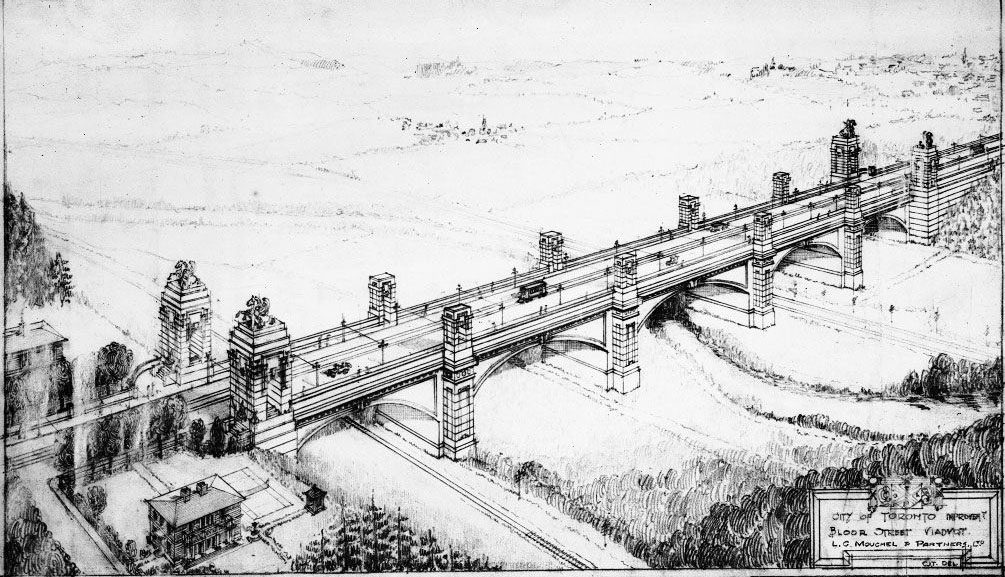
Before the Prince Edward Viaduct could be built, the city of Toronto held annual referendums on the project from 1910 to 1913. Initially, the public voted against the bridge, but eventually, they approved its construction.
While the first plans for a bridge were conceived as early as 1897, work didn’t actually begin until 1913. The initial cost estimate was $759,000, but the final cost soared to nearly $2.5 million. The Prince Edward Viaduct was designed by a team led by Thomas Taylor and Edmund Burke.
The bridge features a brilliant two-level design. The upper deck was originally intended for streetcar traffic, while the lower deck was built to accommodate a future railway. This forward-thinking inclusion of the lower deck saved the city millions of dollars when the Toronto Transit Commission’s (TTC) Bloor-Danforth subway line opened on it in 1966.
The viaduct spans the Don River Valley, connecting Bloor Street with Danforth Avenue. The bridge was instrumental in fostering the rapid development of Toronto’s neighbourhoods on the east side of the Don Valley. Beneath the bridge pass the Don River, the Don Valley Parkway, and Bayview Avenue, as well as two railway lines, a power line, and a bicycle path.
In terms of its scale, the Prince Edward Viaduct has a total length of approximately 494 metres and is composed of three sections: the Bloor Street Viaduct, the Rosedale Valley Bridge, and the Don Valley Viaduct.
The Prince Edward Viaduct: An Important Part of the City
The Prince Edward Viaduct is undeniably essential to Toronto’s infrastructure. However, over the years, the bridge also gained a tragic reputation as a magnet for suicides. By 2003, it had become the deadliest structure in Canada and the second most frequent location for suicide jumps in North America, after the Golden Gate Bridge in San Francisco.
The crisis peaked in 1997, when, on average, one person jumped from the bridge every 22 days. A jump from this height did not guarantee instant death; many who attempted it were left with broken limbs, traumatic brain injuries, or paralysis.
This alarming number of suicides led to the decision to construct a barrier system known as the “Luminous Veil”. The council initially approved a budget of $2.5 million, but the lowest bid for its construction came in at $5.5 million. This award-winning barrier, designed by architect Dereck Revington, was completed in 2003. It consists of over 9,000 steel rods, each spaced 12.7 cm apart and standing five metres high. In 2015, elegant lighting was added to the structure, turning a safety feature into a public art installation.
The barrier’s effectiveness has been debated. A 2010 study suggested that while it stopped jumps from the viaduct, it may not have significantly changed the city’s overall suicide rate. However, a later study in 2017 indicated that it had successfully reduced the number of suicides from the bridge itself.
In conclusion, the construction of the Prince Edward Viaduct was a pivotal moment in the development of Toronto’s infrastructure. The bridge had a significant and lasting impact on the city’s growth, particularly in the east end, by providing a vital transportation link across the Don River Valley.
We hope this article has been informative and that you’ve learned something new about this iconic Toronto landmark.