

In the very heart of Toronto stands the Church of the Holy Trinity, a historic sanctuary built in 1847 as a protest against the commercialization of religious spaces. At that time, in Toronto and much of England, church pews were rented out, limiting access for poorer parishioners. That’s precisely why this church was founded on a unique principle: its pews were to be “free and unappropriated forever,” ensuring everyone could find a place of refuge here. More at toronto-future.
Construction was made possible by a generous donation of £5,000 from Mary Lambert Swale. She passed away at the young age of 25 but left a legacy that changed the course of history. Her will not only stipulated the free pews but also dictated the church’s architecture: a Gothic style, a cruciform (cross-shaped) plan, and an unobstructed view of the altar and pulpit from anywhere in the nave. Swale also gifted a silver communion set, funds for a baptismal font, and donations for the poor, laying the groundwork for the spirit of mutual support that continues to thrive here today.
The Tudor Gothic style building was designed by Henry Bower Lane and constructed by John Harper, renowned for his work on St. Michael’s Cathedral. Using limestone from the Humber Valley and sandstone from Ohio, they created an architectural gem that has truly stood the test of time. The first rector was the Reverend Dr. Henry Scadding, who dedicated not only his labour but also his personal finances to the church—he served without pay for the first two years while also teaching Classics at Upper Canada College.
Stained Glass Windows That Tell Stories
The Church of the Holy Trinity is famed for its stained glass windows, each holding a unique story. For instance, the Grisaille Window, installed in 1868 by the McCausland company, is distinguished by its unique technique of grisaille painting with quatrefoil patterns and coloured borders. Such windows were more affordable as they were often made using stencils and kept in stock by workshops.
One of the most poignant windows in the church is the Osler-Williamson memorial window, donated in memory of Sir Edmund Osler’s first wife, his two children, and his brother-in-law, Alexander Williamson. This window is more than just a work of art; it’s a symbol of love, loss, and faith, shining through coloured glass, reminding all who enter this sacred space of the enduring values of humanity and spirituality.
Window Architecture: Who Are They Dedicated To?
The Church of the Holy Trinity is more than a historical landmark. It’s a place where faith converges with art, where architecture embodies ideals of equality, and where stained glass windows narrate stories that resonate across generations. The church is celebrated for its stained glass—true masterpieces that not only adorn the sanctuary but also tell its history, preserving the memory of individuals and events that have shaped the community. Each window is a language of light and glass, guiding us through the ages.
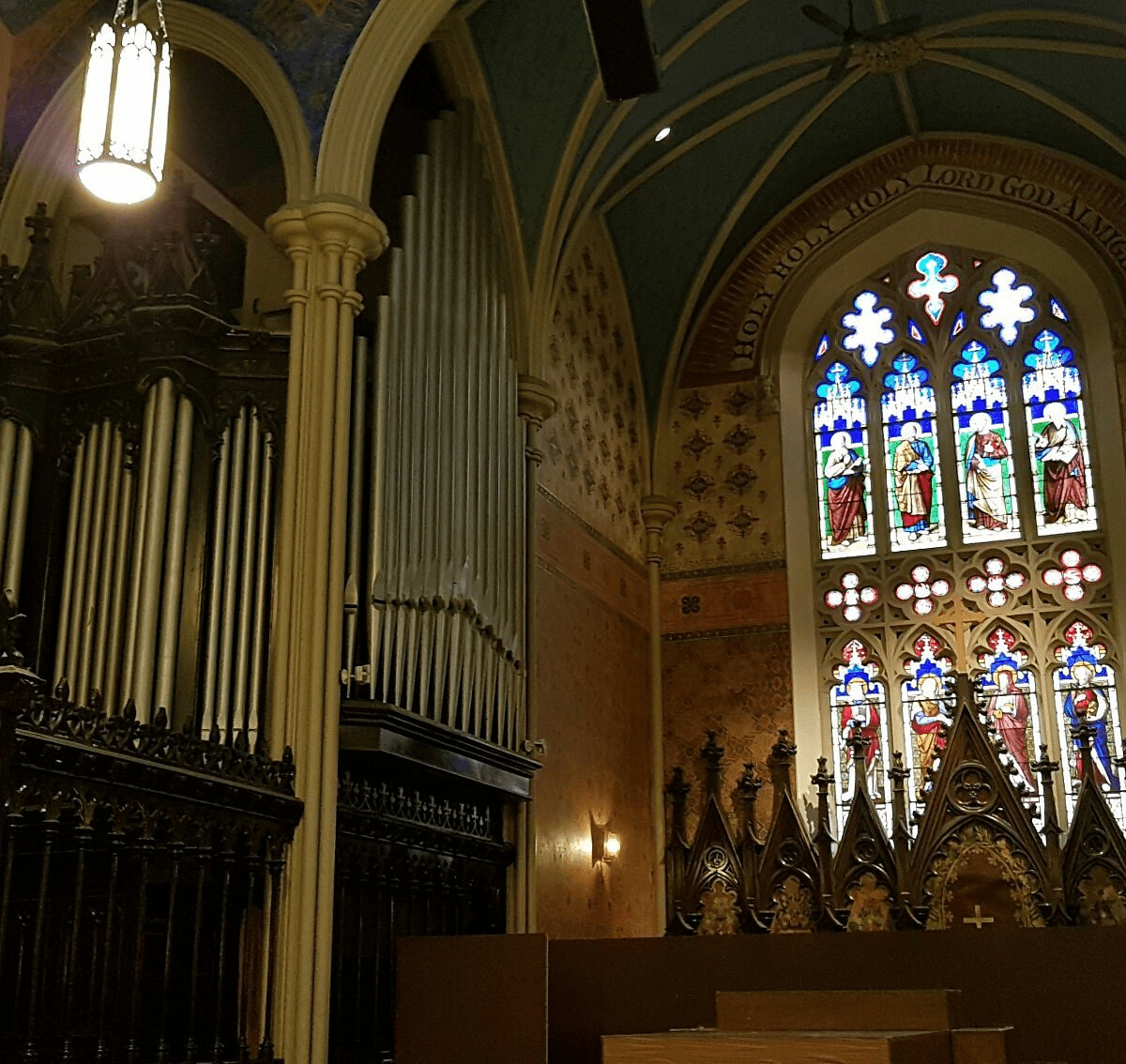
One window, crafted in the Victorian England tradition, is embellished with iconic emblems: the Chi-Rho (Christ’s monogram), Alpha and Omega (symbolizing the beginning and the end), and oak branches with scrolls. Its design draws inspiration from the works of William Morris, blending medieval motifs with elegant simplicity.
Other memorial windows include:
- The Langmuir Window: Dedicated to the memory of Lieutenant Gavin Langmuir, who perished in Ypres in 1915 at the age of 23. He is honoured with a depiction of Saint Michael appearing before Joan of Arc and presenting her with a laurel wreath of victory, alongside a scene of Jesus preaching, dedicated to Gavin’s father. The upper section features the family crest with a helmet and a greyhound.
- The War Memorial Window: Created in 1922, this window commemorates the 32 soldiers who sacrificed their lives in the First World War. The lower panels show two disciples on the road to Emmaus encountering the risen Christ. The upper panels feature the Crucifixion scene, with Mary, John, and Mary Magdalene at the foot of the cross. An inscription on the window reminds us of eternal faith: “And I, if I be lifted up, will draw all men unto me.“
- The South Transept Window: This window is dedicated to Mary Letitia Mondolét and her son. It depicts Jesus blessing the children. Symbolically, the window is situated near the baptismal font, and an angel holds a scroll inscribed with: “Those that seek Me early shall find Me.“
Some windows, created in 1858 and 1870, were Toronto’s earliest examples of figural representations in stained glass art. They feature images of the prophets who foretold Christ’s coming—Isaiah, Jeremiah, Ezekiel, and Daniel—as well as the four Evangelists: Matthew, Mark, Luke, and John. In every window, history comes alive through colours, light, and symbols that reflect enduring faith, memory, and timeless art.
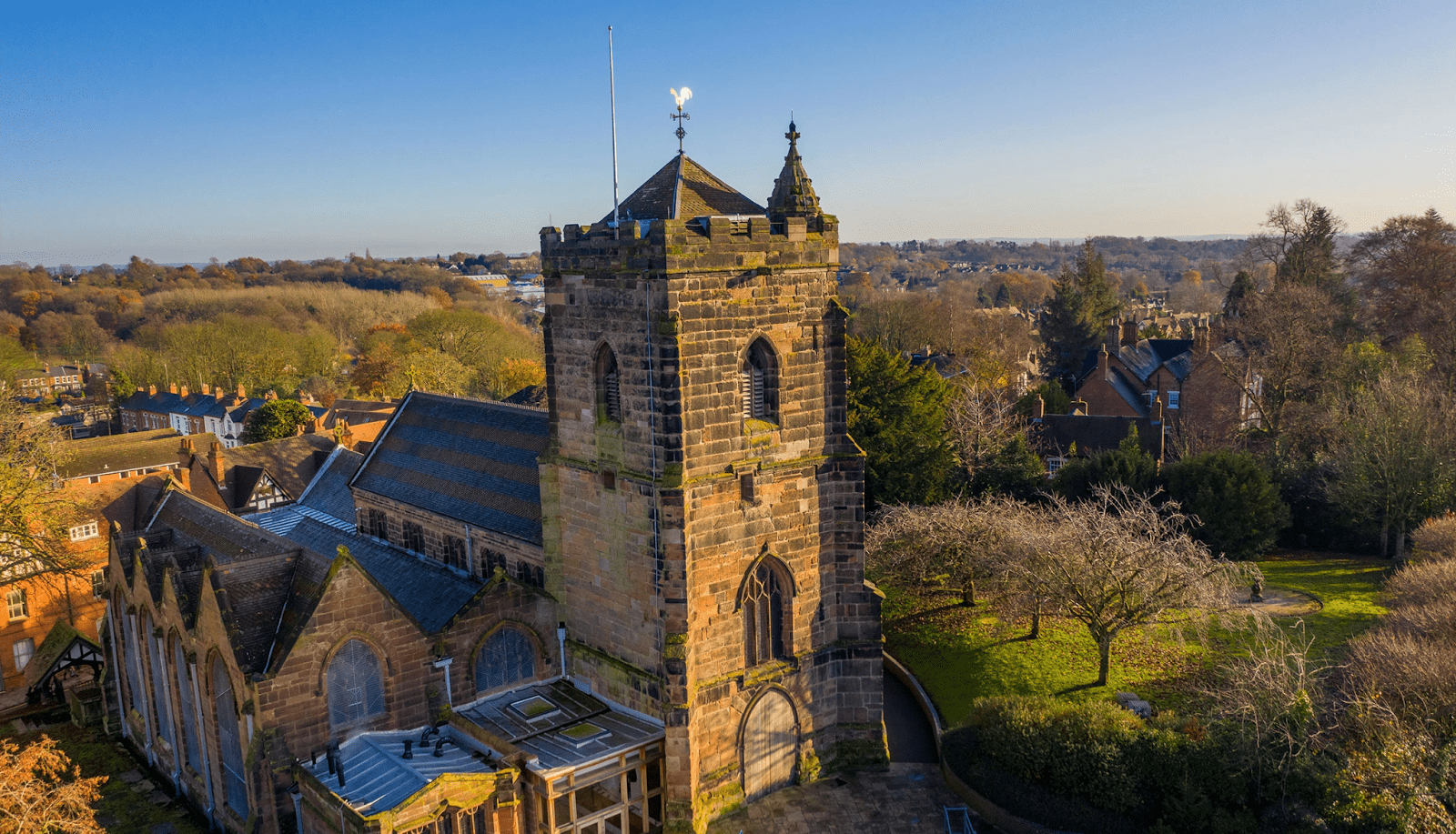
The Fire That Changed Toronto’s Church of the Holy Trinity
On May 9, 1977, tragedy struck: a fire that broke out in the Eaton’s warehouse devastated the church’s roof and a significant portion of its south wall, destroying three unique stained glass windows. Their exact appearance remains unknown, though they were likely crafted by the renowned McCausland studio. That very day, despite the destruction, parishioners gathered outdoors for a service. They made the pivotal decision not to abandon their church but to rebuild it on the same site. As a symbol of hope, the new church ceiling was painted sky blue, a reminder of the day the open sky served as their only vault.
The church community successfully secured compensation from the Cadillac Fairview corporation, owner of the destroyed warehouses, and embarked on a major reconstruction project.
The Story of the Modern Stained Glass Windows
In 1979, the rector, Father Maxted, approached stained glass artist Stephen Belanger-Taylor to create three new windows dedicated to the Holy Trinity.
Every symbol in the windows was discussed with the congregation; parishioners not only approved the designs but also personally voted on the meaning of each element. However, after the project received approval, funding unexpectedly vanished, and implementation was postponed.
When Belanger-Taylor completed another commission, funding for Holy Trinity was reinstated. Together with his assistant, Patti Walker, he installed the three windows. The artist’s wife, Denise Belanger-Taylor, crafted special glass elements for them. The finishing touch was a fourth window, “Gifts of God,” installed in 1982.
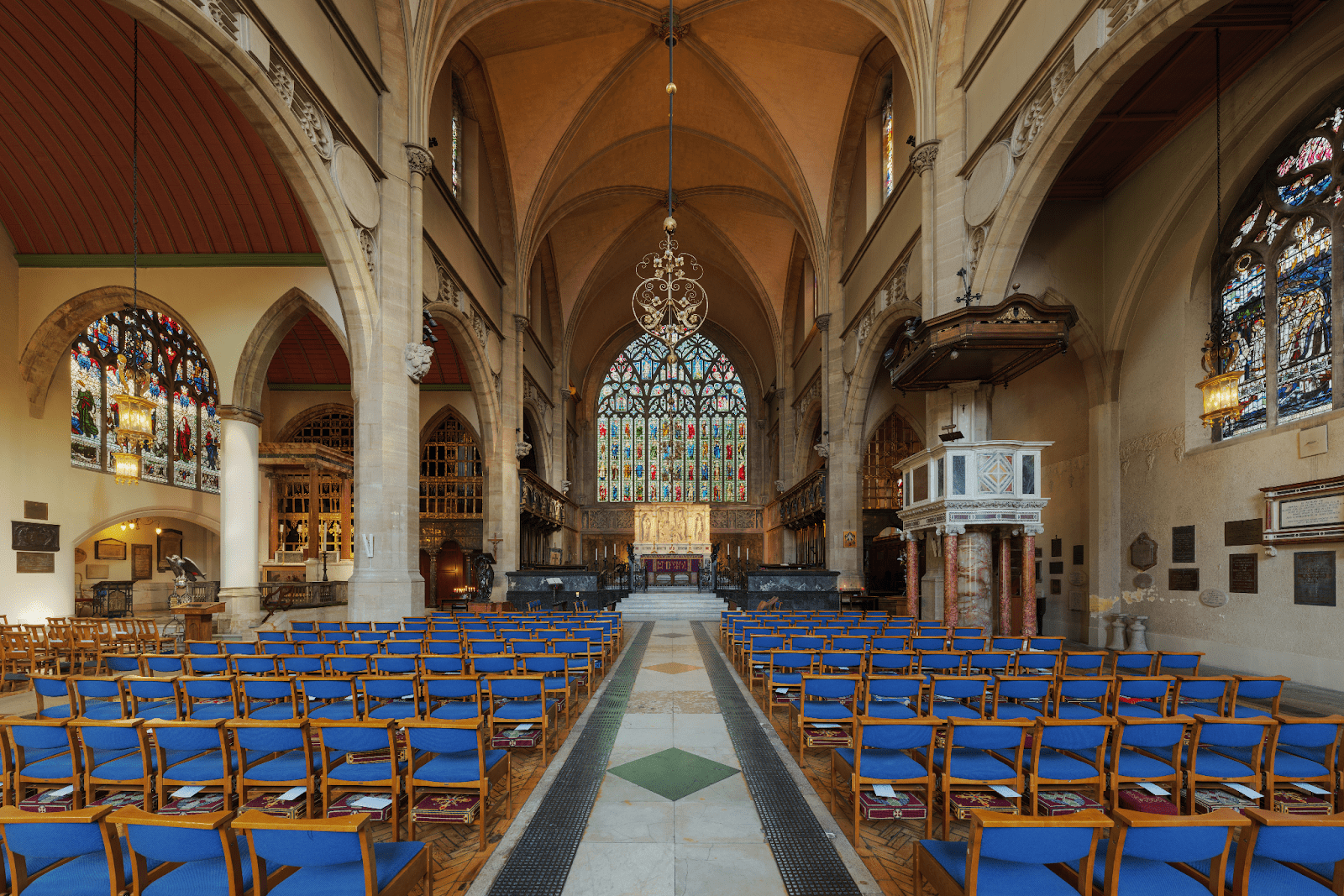
The Holy Spirit and Pentecost
The “God the Holy Spirit” window portrays one of Christianity’s most significant events—Pentecost, when the Holy Spirit descended upon the apostles as tongues of fire. This moment, symbolizing hope and the inspiration to spread the faith, is conveyed through fire, a symbol of God’s presence and purification. The window also depicts the cosmos, where the sun, moon, and stars evoke the majesty of God’s creation, spanning the entire world.
The Church of the Holy Trinity as an Educational and Spiritual Centre
The Holy Trinity Chapel, designed in 1858 by architect William Hay, served as the first school for girls in Toronto. This was a period before public school legislation had been introduced in the province. William Hay also designed two other key buildings adjacent to the church: the residence for the first rector, the Reverend Henry Scadding, and the rectory, which now serves as a hub for parish life and charitable activities. These buildings became the cornerstone for the community’s spiritual and educational development.