

Toronto is home to many historic buildings. A week wouldn’t be enough for tourists to see all its famous architectural sights, as the metropolis boasts an incredible number of them. Today, we’ll explore Toronto’s Old City Hall. This is one of the city’s most renowned architectural landmarks, located right downtown at the corner of Queen and Bay Streets. Read more about the history of this architectural gem on toronto-future.com.
The Story Behind Old City Hall’s Creation
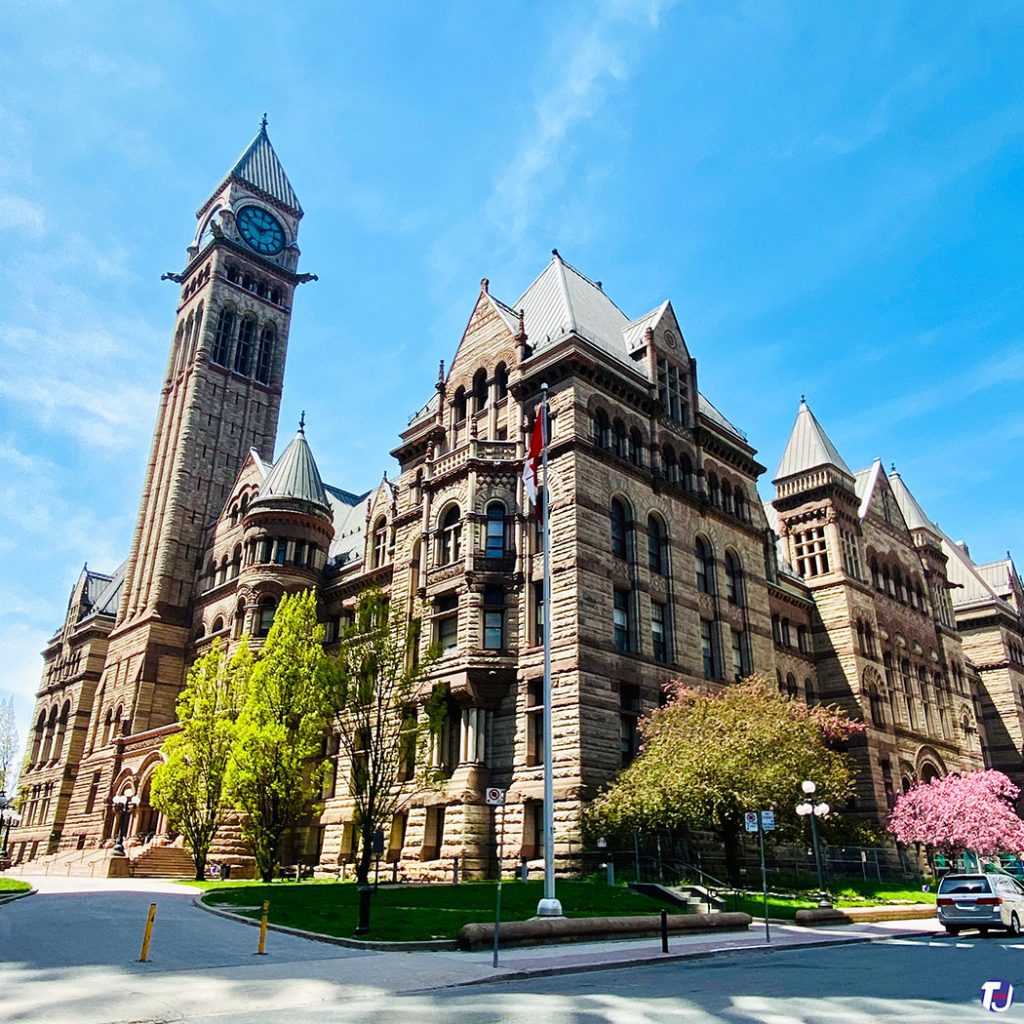
Construction of the city hall began in 1889. The project was designed by architect Edward Lennox. He chose a Romanesque Revival style for the building, featuring a massive clock tower standing 104 metres tall. Interestingly, the city decided to commemorate the architect: Lennox’s name is immortalized among the decorative elements of the first floor, and his likeness also appears as a portrait carving.
It’s worth noting that construction lasted for ten years. The city hall was officially opened in 1899, and at the time, it was the tallest building in Toronto. Moreover, it was the largest municipal building in North America. Overall, the structure became a key centre for civic government. The city hall replaced the previous one located on the site of the present-day St. Lawrence Market.
Until 1966, the building served as Toronto’s city hall. The municipal government then relocated to the new City Hall. Initially, city officials planned to demolish the old structure, intending to leave only the clock tower standing. The idea was to free up space for modern skyscrapers. However, citizens fiercely opposed this plan. As a result, Old City Hall was saved and preserved as a historic landmark. Since then, Old City Hall has been used as a courthouse by the Government of Ontario.
Interesting Facts About Toronto’s Old City Hall
Toronto’s Old City Hall is considered a unique tourist attraction. It’s a popular spot for visitors. In this section, we’ll share some fascinating facts about the building with our readers:
A Decade of Construction: As mentioned earlier, the city hall took ten years to build. This was due to the sheer scale of the project, its complex architecture, and the use of then-modern construction technologies. Upon its completion, it was the largest municipal project in Canada.
A Proud Architect: Architect Edward Lennox was quite well-known in that era. He was immensely proud of his creation, so much so that he decided to carve his own face onto the building’s facade.
Soaring Clock Tower: Old City Hall’s clock tower stands over 100 metres tall. This feature made it the tallest structure in the city at the time.
Budget Overruns: Initially, the city hall’s construction was budgeted at $300,000, but the final cost soared to over $2.5 million.
Unique Materials and Finishes: The facade features sandstone from Ontario, while the interiors are adorned with stained glass windows, marble, and handcrafted wood carvings.
Several legends are also associated with Toronto’s Old City Hall. One legend tells of tunnels beneath the building used to transport prisoners to a nearby jail. This legend is fueled by local tales of strange noises, whispers, and even apparitions of workers who supposedly died during the construction of these underground passages.
As you now know, architect Edward Lennox decided to immortalize his face on the building’s facade. Legend has it this wasn’t done merely for posterity. It’s said to be due to disputes with the city council; Lennox left his mark to ensure he wouldn’t be forgotten as the project’s creator. And another popular legend concerns the threatened demolition of Old City Hall. In 1966, when the building was slated for demolition, public outcry opposed it. But a legend suggests that it was the “spirit of the city” itself that prevented the landmark’s destruction.
So, that’s the story behind the creation of one of Toronto’s iconic symbols. We hope you found this material informative and learned more about your city.