

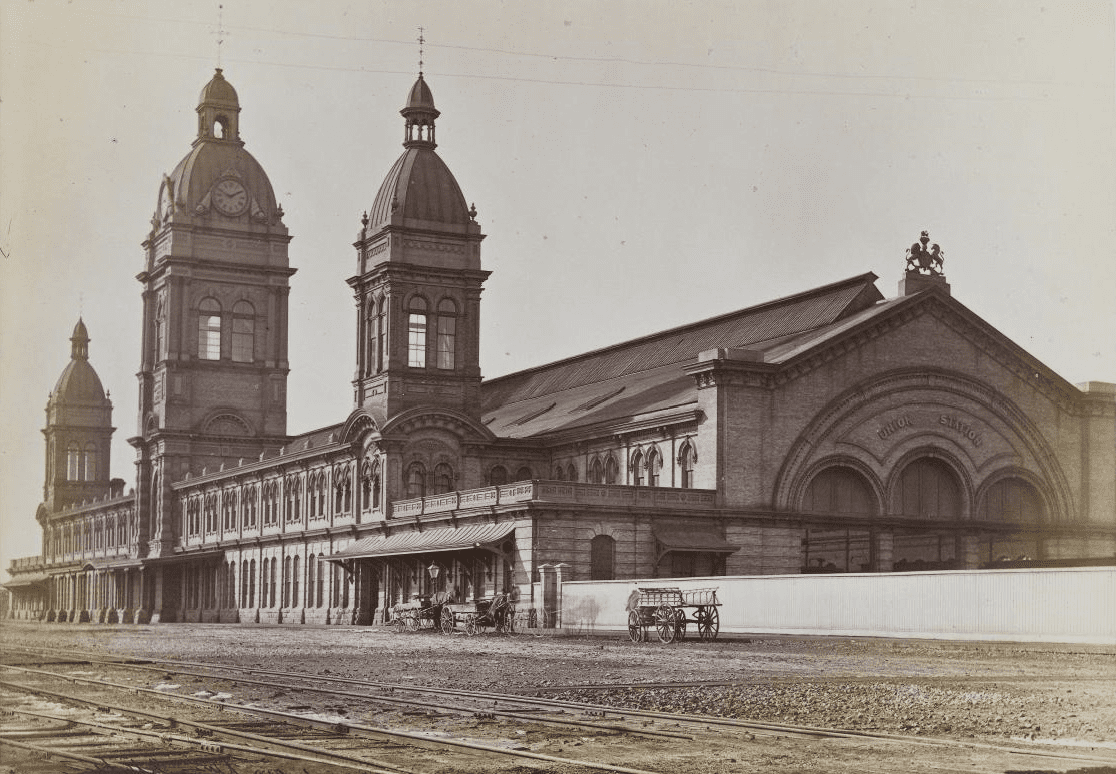
Despite the efforts of railway companies involved in its construction, the second Union Station in Toronto was plagued by fundamental flaws and struggled to manage the daily volume of passengers. Even an expansion in 1896 failed to alleviate these issues for long. This led the railway companies and city officials to pursue a more effective solution. Unfortunately, much of the city block directly east of Union Station was destroyed in the Great Fire of 1904, further complicating matters. Read on at toronto-future.
The Creation of the New Union Station
The Toronto Terminals Railway Company was established on July 13, 1906, to oversee the construction, maintenance, and operation of a new Union Station. Its shares were equally owned by the Grand Trunk Railway and the Canadian Pacific Railway, which intended to share the station. In March of the same year, the two companies jointly awarded a construction contract to Westinghouse, Church & Kerr Company of New York. The contract included the construction of the station and the installation of signalling devices in the nearby corridor, with a projected cost of $1,000,000 and completion expected by February 1908. However, various delays and changes in plans significantly slowed progress.
Initial plans were submitted to railway executives, but little progress was made for several years, aside from debris clearance at the new Union Station site during the summer of 1912. The relationship between Westinghouse, Church & Kerr Company and Grand Trunk Railway dissolved when the former sued the latter for $1 million, citing a breach of contract. A new contract was signed with Peter Lyall & Son of Montreal on July 7, 1914. However, another significant delay arose in the form of World War I, which Canada entered a month later. By 1918, the main section of Union Station was finally constructed, though much work remained to be done.
The Design of Union Station
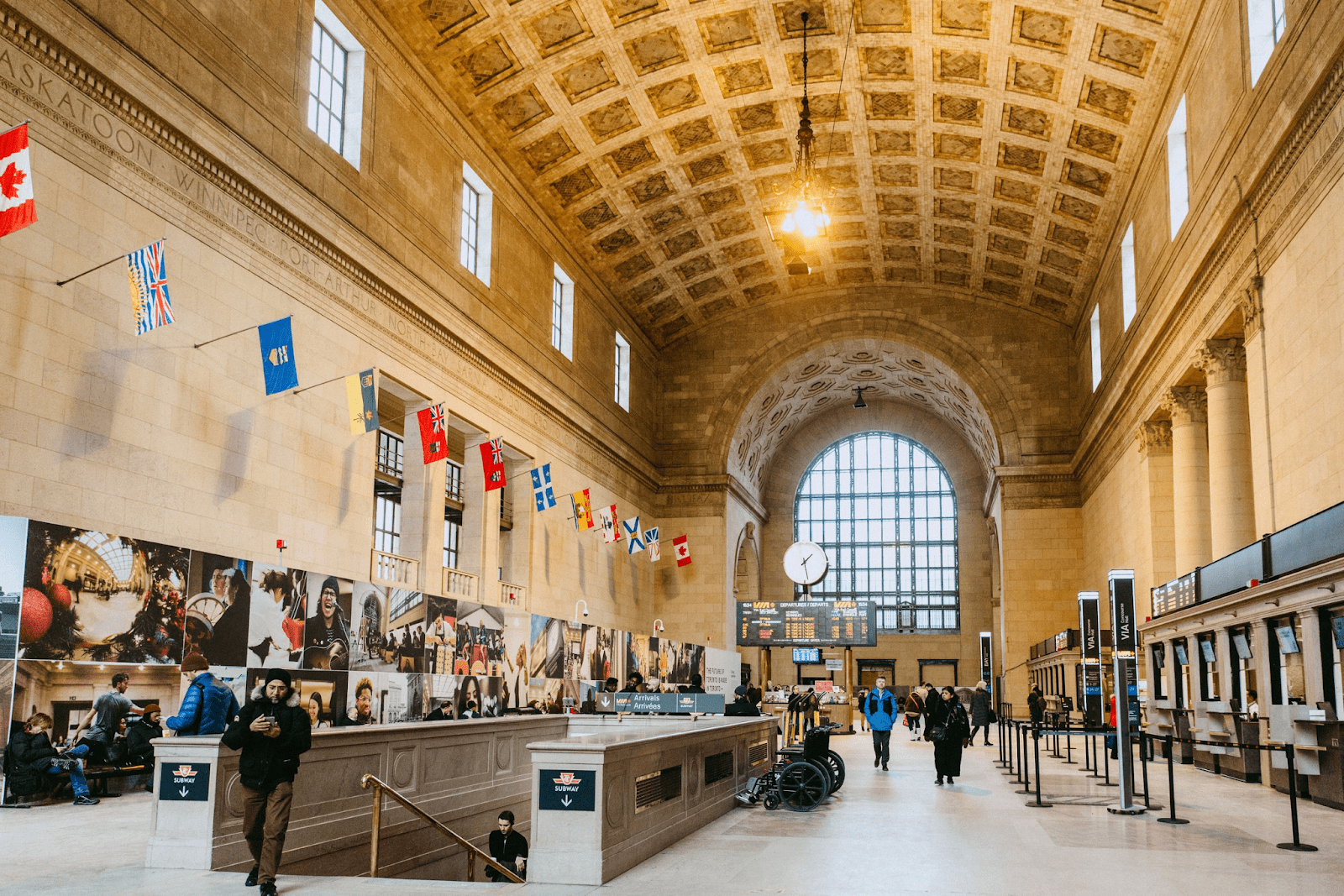
The station’s design adhered to the Beaux-Arts architectural style, which was immensely popular for major North American railway terminals at the time. Its exterior was almost entirely clad in beige limestone, featuring a colonnade with 22 Doric columns at the main entrance. Upon entering, passengers were greeted by a vast Great Hall, 79 metres long, with an arched ceiling soaring 26 metres overhead. Minnesota-sourced Zumbro stone was chosen for the interior walls due to its reflective qualities, while Tennessee marble was used for the floors and staircases.
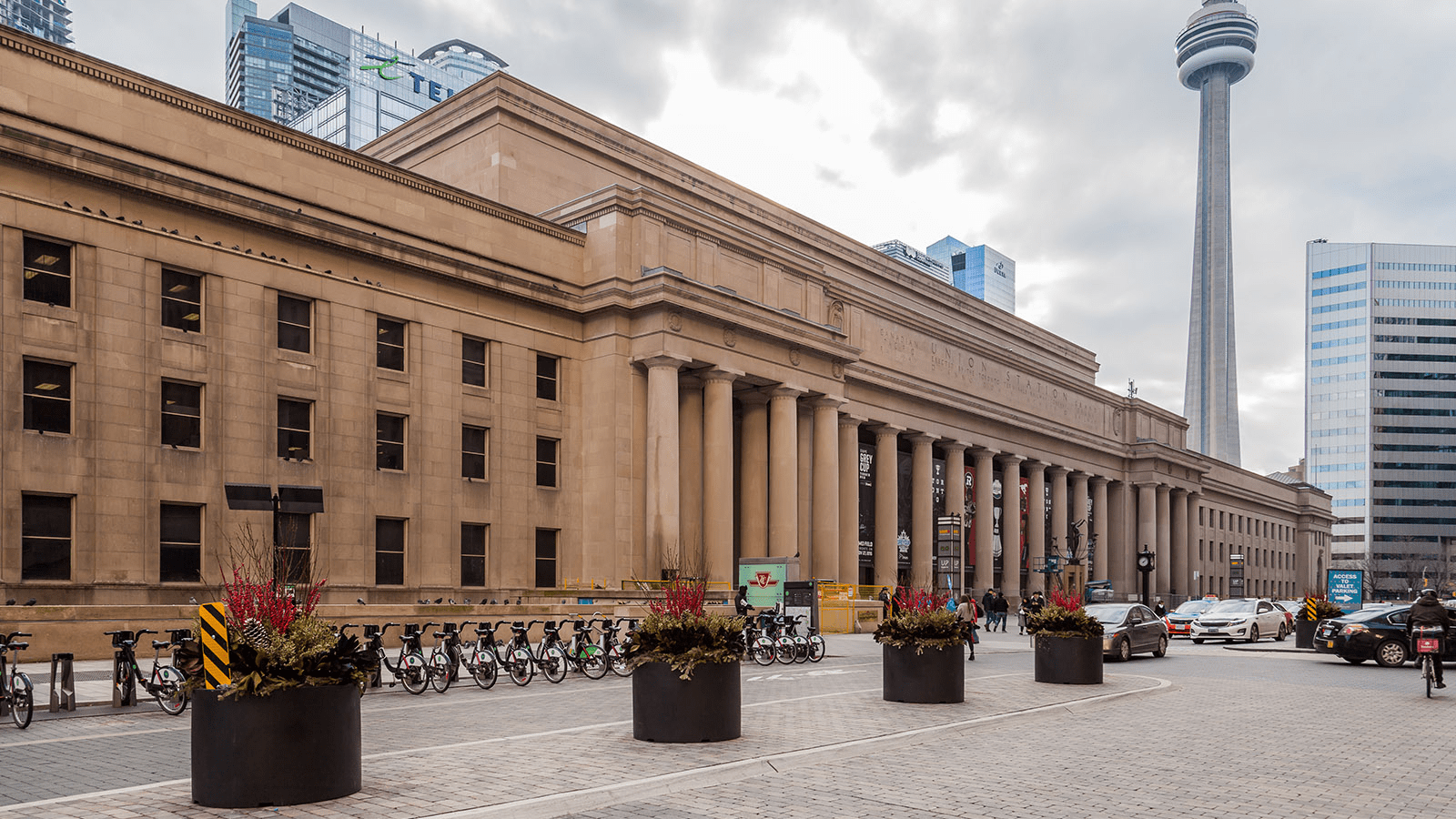
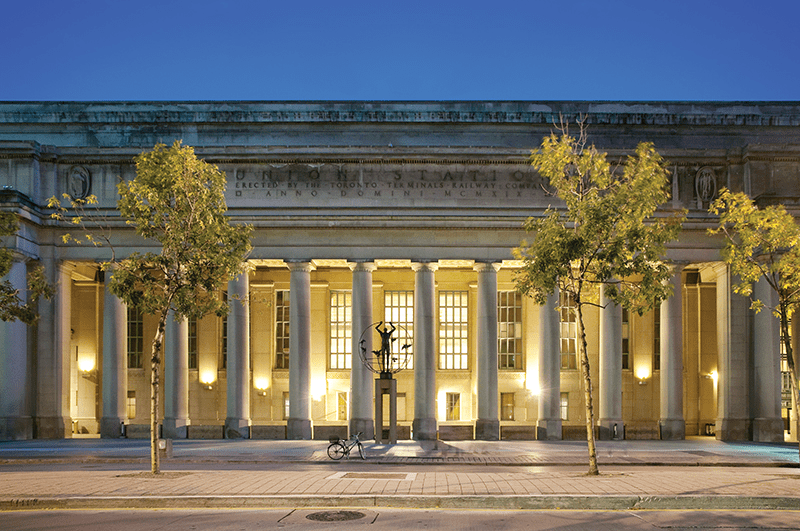
Many architectural historians regard the Great Hall as one of Canada’s finest public spaces. In 1919, stonemasons engraved the names of all major Canadian cities connected to Toronto by passenger rail onto the walls inside the hall. Additionally, the names of Grand Trunk Railway, Canadian Pacific Railway, and Toronto Terminals Railway were engraved on the station’s exterior facade along Front Street. By 1920, the east and west wings of the station were occupied by the postal and railway offices, respectively, but much of the station remained unused.
Opening by Edward VIII and Passenger Volumes
The Grand Trunk Railway faced financial difficulties in the early 20th century, culminating in its nationalization and absorption into the newly established Canadian National Railway (CNR) in 1923. Grand Trunk’s shares in the Toronto Terminals Railway transferred to CNR. By 1924, it was decided that the railway corridor needed to be elevated above roads from the new station eastward to Coxwell Avenue. Construction of the new railway corridor and station platforms began in 1925.
The new Union Station was officially opened by King Edward VIII on August 6, 1927, though passengers initially used temporary platforms at the old station site. Platforms 1 through 6 and the northern section of the railway corridor became operational on January 21, 1930, with the remainder completed by December of the same year. Unfortunately, by that time, the Great Depression had already begun, significantly impacting passenger volumes. In 1933, an agreement between Canadian Pacific and Canadian National combined their Toronto-Montreal trains to improve efficiency, a practice that lasted until 1965.
Passenger volumes rebounded during World War II, with over 90 to 100 trains passing through Union Station daily in the postwar period. However, this resurgence was short-lived as automobiles and air travel began reducing demand for passenger rail services. Around this time, streetcar tracks on Front Street were removed to accommodate additional traffic lanes, marking the end of a vital transit connection to Union Station. After the controversial demolition of Pennsylvania Station in New York City, Union Station faced similar threats. Media outlets published critical comments about the station, predicting or advocating for its replacement. A proposal to replace the main building with a massive “Metro Centre” gained traction among railway officials. However, advocacy groups and support from Mayor David Crombie successfully protected the station. Union Station was designated a National Historic Site of Canada in 1975, safeguarding it from demolition. While the Metro Centre plans were abandoned, elements like the CN Tower and Metro Convention Centre were built elsewhere.
Avoiding Congestion and Preserving Union Station
In 1967, the province established GO Transit to launch commuter rail services between Pickering, Union Station, and Oakville, partly to reduce traffic congestion on Highway 401. GO Transit’s mandate gradually expanded over the following decades to include routes to Kitchener, Barrie, and Richmond Hill, often replacing services previously offered by other companies or agencies. In 1977, Canadian National separated its regional and intercity passenger services into a crown corporation called VIA Rail, which took over all remaining Canadian Pacific passenger services in 1978. Direct rail service from Union Station to the United States was jointly restored by VIA Rail and Amtrak in 1981, while streetcar service returned to Union Station in 1990 via an underground tunnel. In 2000, the City of Toronto purchased the main Union Station building, while Metrolinx acquired the shed and railway corridor.
Over the last few decades, passenger volumes at Union Station have steadily increased. This growth is partly attributed to rising traffic congestion, making commuter rail a more viable option for many, along with the densification of downtown Toronto and improved transit connections. Between 2005 and 2021, the station’s interior was renovated and modernized, including the addition of a new concourse and the preservation of Beaux-Arts elements in contemporary spaces. Today, Union Station serves over 50% of VIA Rail’s passengers and 91% of GO Transit’s riders, cementing its importance as Toronto’s central transit hub in the 21st century.