

The oldest software development laboratory in Canada, located in Toronto, is the only facility in North America where all five major IBM software brands are developed. More details on toronto-future.
General Information About the Corporation
The International Business Machines Corporation (IBM) in Toronto is a global computing company with expertise in recording, processing, transmitting, storing, and retrieving information. IBM has maintained a strong presence in Canada since 1917. IBM Canada hosts the largest team of software specialists outside the United States, with software development labs in Markham, London, Ottawa, Montreal, Edmonton, Vancouver, and Victoria. Collectively, these sites are known as the IBM Canada Lab. Additionally, the IBM manufacturing plant in Bromont, Quebec (opened in 1972), is the company’s largest semiconductor packaging and testing facility, employing nearly 2,800 people. This plant also packages chips used in home gaming consoles and is one of Canada’s leading exporters. Since its establishment in 1967, the Toronto lab has grown to over 2,500 employees, making it the largest IBM software lab in Canada and the third-largest IBM lab globally.
The Company’s Early History
IBM’s origins trace back to the late 19th century through its predecessor, the Computing-Tabulating-Recording Company (CTR), which comprised three merged companies. CTR sold a variety of products, from deli slicers and commercial scales to tabulators and punch cards. The company was incorporated in 1911 by Charles R. Flint and headquartered in New York, employing 1,300 people across several U.S. branches. In 1917, CTR opened its Toronto office under the name International Business Machines Co., Ltd., marking the first use of this name. In 1914, Thomas J. Watson joined as general manager, soon introducing new business practices that defined the company: positive outlooks, excellent customer service, and the motto “THINK.” Watson became president in 1915, and within four years, the company’s revenue more than doubled. CTR expanded into Europe, South America, Asia, and Australia.
Name Change and the Largest Accounting Operation
World War I created opportunities for CTR to expand its production of autographs and electric accounting machines. By 1924, the company had significantly grown through patent acquisitions and purchasing competitors’ assets. On February 14, 1924, CTR officially changed its name to International Business Machines Corporation, creating the global IBM brand.
During the Great Depression, IBM continued to grow by keeping workers in both Canada and the U.S. employed, manufacturing new machines despite a decline in demand. This positioned IBM to win a landmark U.S. government contract following the passage of the 1935 Social Security Act. IBM was tasked with maintaining employment records for 26 million people, marking the largest accounting operation in history. The success of this contract ensured IBM’s future collaborations with the U.S. government.
Early Computing Systems and Leadership Transition
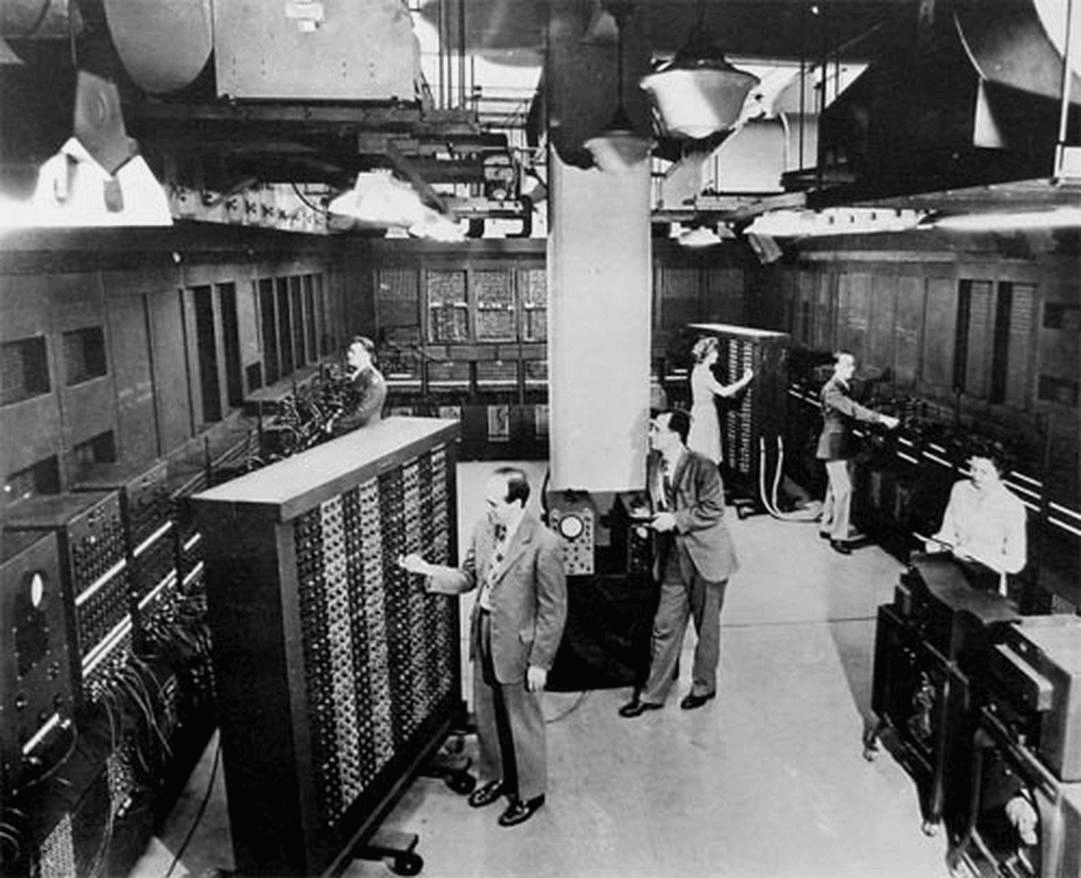
At the onset of World War II, all of IBM’s resources, including its Canadian branches, were mobilized to support the U.S. government’s wartime efforts. The company’s product range expanded to include bomb sights, rifles, and engine parts. This period also marked IBM’s first venture into computer development, producing the Automatic Sequence Controlled Calculator in 1944. The machine was over 50 feet long, 8 feet tall, and weighed nearly five tons.
In 1948, IBM introduced the first large-scale digital computing machine (Selective Sequence Electronic Calculator), the Electronic Calculating Punch, and the Card-Programmed Electronic Calculator. By the mid-1950s, IBM developed transistor-based computers, significantly increasing calculation speeds. The IBM 7090 could perform 229,000 calculations per second and was used by the U.S. Air Force for its ballistic missile early warning system. In 1957, IBM launched the RAMAC (Random Access Method of Accounting and Control), the first computer disk storage system capable of retrieving data from any of its 50 disks in less than a second. The same year, IBM introduced FORTRAN, a computer language based on algebraic rules, grammar, and syntax, becoming one of the most widely used languages.
In 1952, Thomas J. Watson handed leadership of the company to his son, Thomas Watson Jr., who believed that computers would play a central role in the future of business. Under Watson Jr.’s leadership, IBM innovations positioned the company as a leader in the computer industry.
Personal Computing and Defeating a Chess Champion
A new era in computing began in 1981 with the introduction of the IBM Personal Computer (IBM PC). IBM entered homes, schools, and small businesses with 16 kilobytes of user memory, one or two floppy drives, and an optional colour monitor. The IBM PC was developed in partnership with external companies, including Intel (for its processor chip) and Microsoft (then a 32-person company, for its Disk Operating System, DOS).
In the 1980s, IBM streamlined its operations and resources. Investments in research produced four Nobel Prize winners during the decade and laid the groundwork for networked computing. However, the early 1990s were challenging, as the personal computer revolution shifted systems directly into consumers’ hands. By 1993, IBM faced an $8 billion net loss but stabilized in the following years by focusing on integrated solutions and rebuilding its product lineup. IBM regained prominence as interconnectivity became a dominant business need.
In May 1997, IBM demonstrated its computing power when its 32-node IBM RS/6000 SP “Deep Blue” defeated world chess champion Garry Kasparov. By 2000, IBM had reestablished itself as a leader in the information technology sector.
In 2011, IBM celebrated its centennial year with the Watson computer system captivating global audiences on the game show Jeopardy!. Watson defeated two of the show’s most successful contestants. Watson, a cluster of Power 750 servers operating at over 80 teraflops, used software known as Deep QA.
Sources: