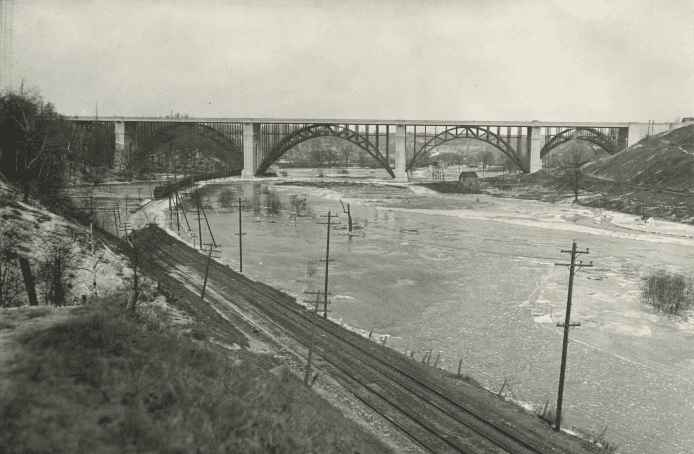

The Prince Edward Viaduct in Toronto has a rich and fascinating history. This three-hinged concrete-steel bridge spans 494 metres and rises 40 metres above the Don River Valley. It connects Bloor Street with Danforth Avenue, serving as a critical transportation link. The viaduct was officially opened on October 18, 1918. Learn more about its construction and unique features on toronto-future.com.
The Growing Need
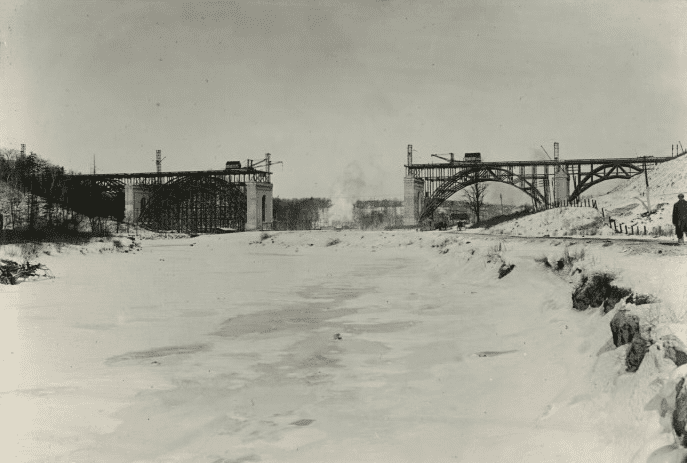
By 1888, only two bridges crossed the lower Don River—one on Gerrard Street and the other on Queen Street. These bridges were insufficient to handle the increasing volume of traffic, especially as people began moving eastward to take advantage of more affordable real estate.
Recognizing this challenge, Toronto city officials acknowledged the need for a new bridge to connect Bloor Street and Danforth Avenue as a practical transportation solution. However, no immediate steps were taken.
On September 16, 1901, Alderman Oliver proposed the construction of a viaduct to the city council. He also requested a preliminary report from the city engineer on the most practical method and estimated cost of connecting Bloor Street East with Danforth Avenue.
The council was slow to act. Discussions about the viaduct took place in 1906 and 1907, but it wasn’t until 1909 that the proposal was seriously considered. That same year, East Toronto, located north of Danforth Avenue, was annexed into the city. Previously, in 1884, Riverside and Leslieville, situated further south, had also been annexed. These eastern suburbs were largely isolated from downtown Toronto by the Don and Rosedale Valleys.
Before construction began, a public referendum was held in 1910. A majority of Toronto residents voted in favour of building the viaduct.
In early 1910, the city hired transportation consultants Jacobs and Davies to study the feasibility of adding a subway line beneath the bridge. City officials believed a subway would be the best solution to congestion problems. After the study, it was determined that constructing a road capable of supporting subway trains was practical. On August 25, 1910, the city council approved this addition, designating the viaduct’s second level for subway trains.
Construction of the Viaduct
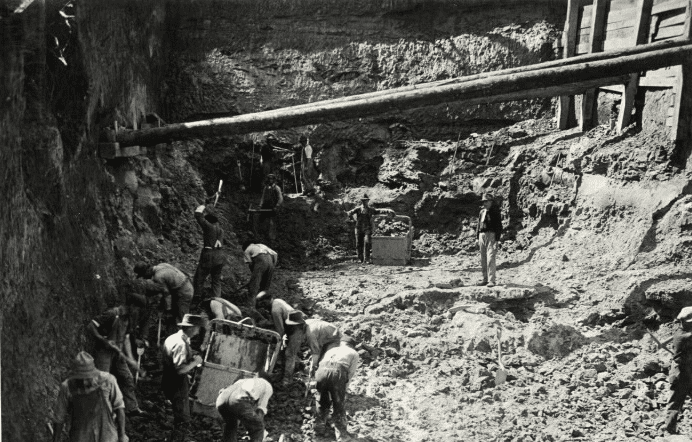
The project cost the city $2.4 million and was officially approved in 1913.
Roland Harris, then Commissioner of Public Works, was appointed to oversee the viaduct’s construction. A significant number of workers, many of whom were immigrants to Toronto, were involved in the project.
The Prince Edward Viaduct was meticulously designed by some of the best minds of the time. Architect Edmund Burke and engineer Thomas Taylor collaborated on the project. The main contractor was Montreal-based Julian Robertson, while the Hamilton Bridge Works Company supplied the steel structures as a subcontractor. Architect and consultant Edmund Burke, a proponent of the “City Beautiful” movement, played a significant role in the project. Construction officially began on June 16, 1915.
In 1918, the viaduct was named after the Prince of Wales, later King Edward VIII. The bridge was built with three sections: one for vehicles, one for streetcars, and another for subway and rail transport.
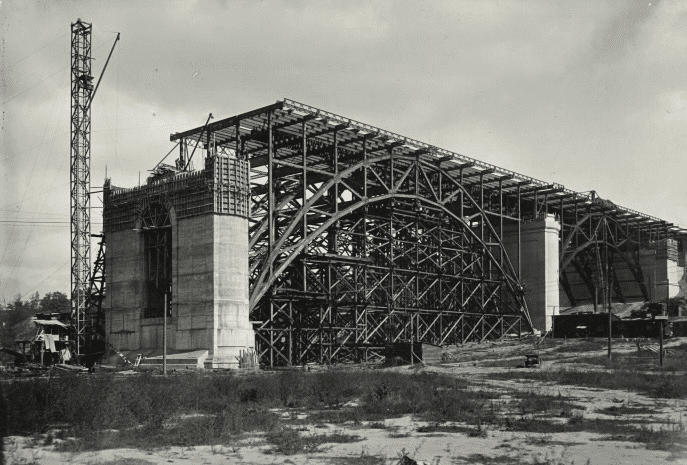
This massive structure consists of a deck supported by cross beams and I-beams, which transfer the load to column supports. The weight is then distributed to the arches. The viaduct is made of steel and features two railway lines, a power transmission line, and a bike path underneath.
In 1960, the viaduct was adapted to extend the Bloor-Danforth subway line. The bridge represents an intriguing combination of architectural artistry, courtesy of Burke, and functional engineering aesthetics, thanks to Taylor.
The Prince Edward Viaduct remains a landmark in Toronto, symbolizing the city’s growth and innovation while addressing its transportation needs.