

They say great inventions are born at the intersection of disciplines. The story of John “Jack” Hopps is the perfect proof. A man who never dreamed of a career in medicine, and who started out studying the pasteurization of beer, eventually became the “father of biomedical engineering.” He invented a device that keeps millions of people alive today. Read more about how the first pacemaker came to be at toronto-future.com.
Beginning the Journey: An Engineer from Winnipeg
John “Jack” Alexander Hopps was born in 1919 in Winnipeg, Manitoba. From an early age, he showed a remarkable aptitude for the exact sciences. To him, engineering wasn’t just a set of dry formulas. It was the most pragmatic way to apply human intellect to solve real-world problems.
After graduating from the University of Manitoba in 1941 with a degree in electrical engineering, Hopps immediately landed a job at the National Research Council of Canada (NRC) in Ottawa. It was a prestigious institution driven by a spirit of experimentation. Initially, Hopps worked on radar systems for the military, but after the war, he shifted his focus to civilian projects. Notably, he developed methods to rapidly pasteurize beer using radiofrequency radiation. Hopps was so passionate about this work that when asked to join a medical research group in Toronto in 1949, he brushed it off as an “annoying interruption of truly important work.”
When Medicine Met Engineering
At the time, cardiac surgeon Wilfred Bigelow and his assistant John Callaghan were conducting bold, even risky, experiments at Toronto’s Banting Institute. They were searching for a way to perform open-heart surgery. The main hurdle was stopping blood circulation for an extended period without causing irreversible brain damage.
Bigelow hypothesized that if a patient’s body was cooled—a process known as induced hypothermia—their metabolism would slow down. Oxygen demand would drop, and surgeons could safely stop the heart to operate. However, a critical problem emerged. When cooled below a certain temperature, a healthy heart would either freeze or go into chaotic fluttering, known as fibrillation. Restarting it to a normal rhythm post-surgery was nearly impossible. Traditional manual heart massage often damaged tissues, and adrenaline injections were simply too aggressive.
This was exactly when John Hopps joined the team. His expertise in radiofrequency heating was supposed to help regulate body temperature safely, but a massive breakthrough was waiting for them elsewhere.
An Accidental Miracle in the Lab
During an experiment on a dog in 1949, the animal’s heart suddenly stopped. Acting out of pure desperation, Dr. Bigelow touched the heart’s sinus node with an electrical probe he happened to have on hand. To the researchers’ amazement, the heart contracted instantly. By applying repeated short impulses, they managed to get the organ beating in a steady rhythm again.
It was a massive “Eureka!” moment. They realized the heart isn’t just a muscle; it’s an electrical system that can be controlled externally. Bigelow and Callaghan immediately tasked Hopps with creating a device capable of generating these impulses consistently and safely.
The First Prototype: The Size of a Radio
Hopps tackled the problem like a true engineer. To him, the heart was simply a complex pump that needed the right electrical signal. In 1950, he built the world’s first artificial pacemaker. The device was bulky, heavy, and completely immobile—but it worked.
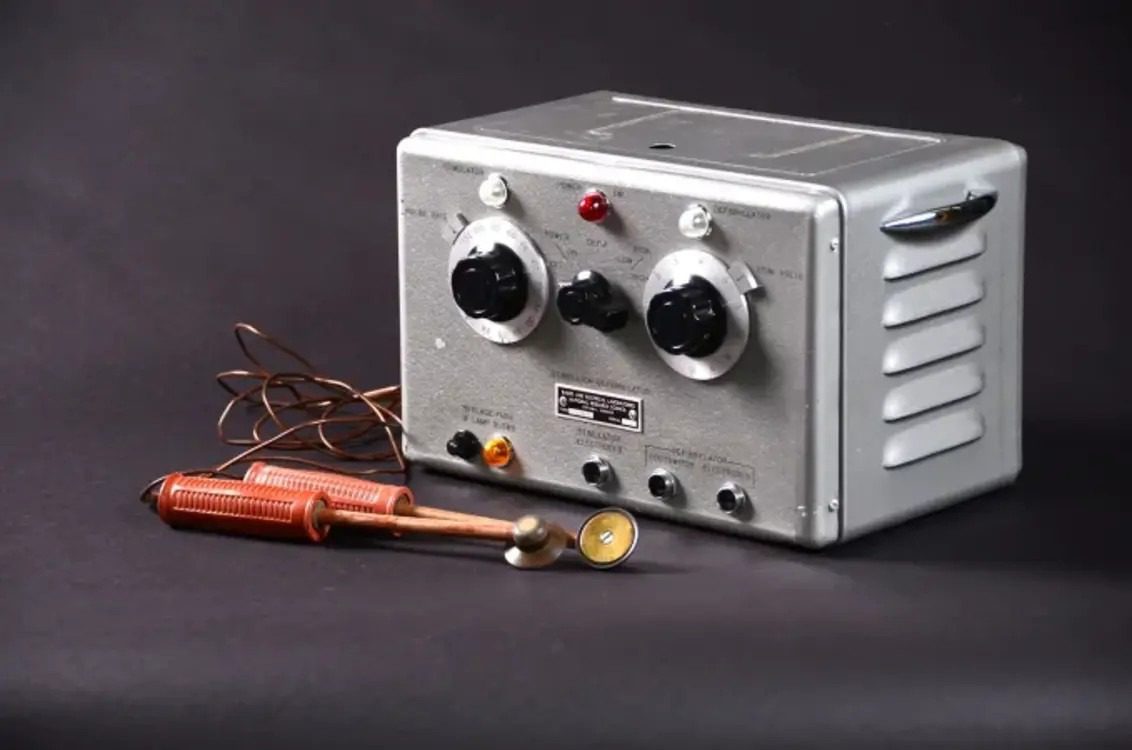
The original pacemaker was about 30 centimetres long and ran on vacuum tubes. The main issue was the power source. Because reliable, compact batteries didn’t exist back then, the machine had to be plugged directly into a standard electrical grid. The patient was literally tethered to the wall. This posed massive risks: a power surge or a sudden blackout in Toronto could mean instant death.
Hopps didn’t stop there. He also developed the transvenous catheter electrode. Instead of cutting open the chest—a huge risk for any patient—Hopps proposed threading a thin, insulated wire through the jugular vein directly into the heart chamber. This groundbreaking technique became the gold standard in cardiology for decades to come.
Ethical Barriers and Public Backlash
Today, it’s hard to imagine such a life-saving invention facing pushback. Yet, when Hopps and Bigelow presented their findings at a medical conference in St. Louis in 1950, the community was shocked. Many viewed the device as “interfering with God’s design.” The idea that a machine could control human life sparked genuine fear.

History recalls the case of Australian doctor Mark Lidwill, who used electricity to revive a baby back in 1926. Facing intense religious pressure and fear of public backlash, he completely abandoned his research. John Hopps and his Canadian colleagues didn’t just have to overcome technical hurdles; they had to shift society’s entire mindset on biomedical technology. Hopps always emphasized a key point: he wasn’t creating life. He was simply using engineering to repair a damaged “biological mechanism.”
The Evolution of the Device
Hopps’s invention proved the core concept: the heart could be effectively stimulated from the outside. With the advent of transistors in the late 1950s, the devices rapidly shrank in size.
In 1958, Swedish engineer Rune Elmqvist and surgeon Åke Senning took the next big step by creating the first implantable pacemaker. It was roughly the size of a shoe polish tin and contained just two transistors. The first patient was 43-year-old Arne Larsson, whose heart was stopping up to 30 times a day. While the first two implants failed fairly quickly, the technology proved its viability. Larsson lived to be 86, outliving both his doctor and the inventor. Over his lifetime, he went through 26 different devices, becoming a living symbol of biomedical engineering’s success.
The Legacy of the “Father” of Biomedicine
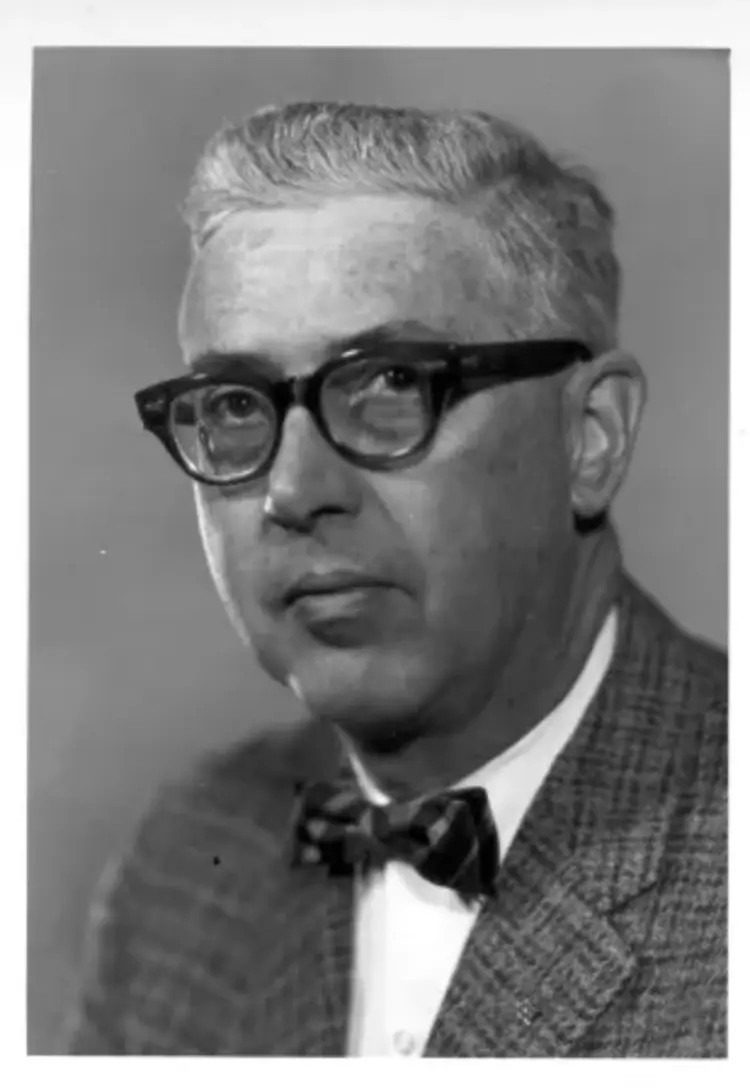
John Hopps didn’t stop at the pacemaker. Returning to the National Research Council, he headed up the medical engineering department. His team developed assistive devices for the blind, innovative ventilators, and some of the world’s very first diagnostic ultrasound systems.
In 1965, he founded the Canadian Medical and Biological Engineering Society and later led international federations, bringing together engineers and doctors from across the globe. His monumental contributions were recognized with the Order of Canada and induction into the Canadian Science and Engineering Hall of Fame.
The Boomerang Effect
Life had an ironic twist in store for John. In 1984, the man who had built the first pacemaker prototype thirty years earlier began to feel a familiar weakness. The diagnosis was definitive: heart block.
John Hopps received an implanted pacemaker—a direct descendant of the bulky box he had designed in his lab back in 1950. In 1997, he underwent a routine surgery to have the battery replaced. Hopps often joked that he was one of the few engineers who literally carried their life’s work close to their heart.
John “Jack” Hopps passed away on November 24, 1998, in Ottawa. He left behind a world where a diagnosis of “cardiac arrest” was no longer a final sentence. His life stands as a testament to how a humble engineer, armed with electrical expertise and a genuine desire to solve a problem, can give millions of people extra years of life.
Today, pacemakers are complex, coin-sized computers that can run for decades and transmit real-time data to doctors over the internet. But at the core of every single device lies the spark John Hopps ignited in that NRC lab, merging medicine and engineering forever.