

Toronto is home to a vast number of interesting locations, cultural institutions, and museums. Both locals and tourists love to visit such places. Today, we’ll talk about one of the largest museums in North America and the largest in Canada, which attracts over a million visitors each year. We are talking about the Royal Ontario Museum (ROM). This museum of art, world culture, and natural history in Toronto is a must-visit. Read more about it on the toronto-future.com website.
The Museum’s Founding History
The history of the Royal Ontario Museum dates back to 1912. It was in this year that this cultural centre was founded. Just two years later, the Royal Ontario Museum opened its doors to visitors. It is worth noting that the museum’s construction cost $400,000. However, this was only the first stage of a two-part construction plan. The plans included further expansion of the museum. That is why, a few years later, a reconstruction of the ROM took place, costing $1.8 million. These funds were used to build the east wing adjacent to Queen’s Park. Incidentally, this reconstruction occurred during the Great Depression and involved the use of local building materials and labour. The museum opened in October 1933.
Overall, the original ROM building was designed by architects Darling and Pearson in an upper-class style of the 17th and 18th centuries, with a strong emphasis on monumentality.
Reconstruction and Expansion of the Royal Ontario Museum
In 1947, the museum was dissolved as a legal entity. It came under the administration of the University of Toronto. The museum remained part of the university until 1968. In that same year, the museum opened its own planetarium. It was built with funds from Colonel Samuel McLaughlin, who donated two million dollars to the ROM. The planetarium operated for several decades and was closed in 1995. It was temporarily reopened, and in 2009 the premises were sold to the University of Toronto for $22 million.
In 2002, another reconstruction took place. The expansion project was named Renaissance ROM. The government provided $60 million for the museum’s reconstruction. An additional $30 million was donated by Michael Lee-Chin.
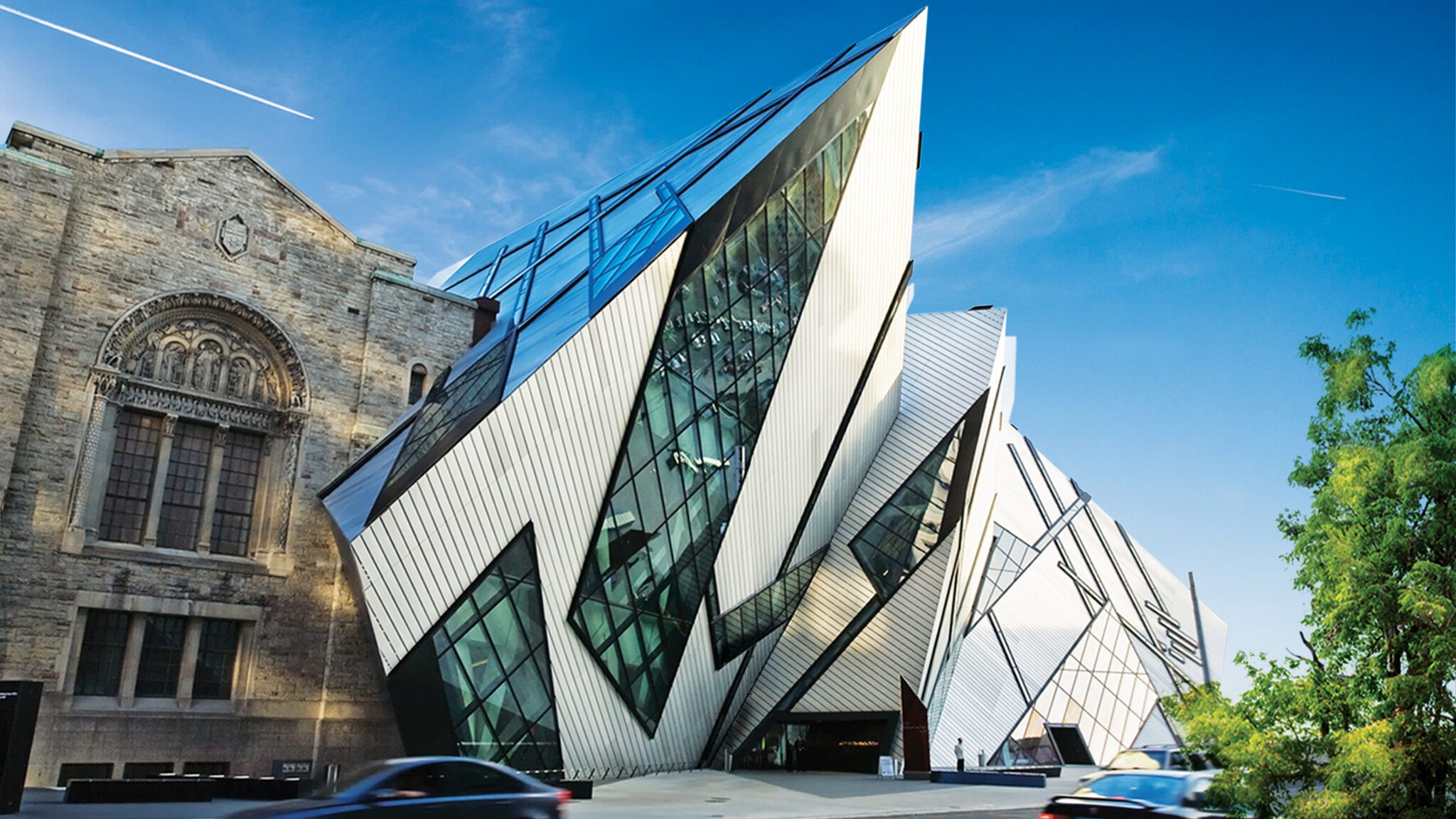
In 2008, the museum underwent a significant renovation, during which a new crystalline addition, designed by Daniel Libeskind, was added. This modern design has become one of Toronto’s landmarks and attracts millions of visitors.
The Royal Ontario Museum is constantly undergoing changes and expansions. Since February 2024, a significant portion of the museum facing Bloor Street has been under reconstruction.
What You Can See in the Museum
While the museum’s exterior and interior are impressive, what truly matters is its content. The Royal Ontario Museum boasts over 18 million objects and 40 galleries. Here, you can see diverse collections of world culture and natural history. Among the most famous exhibits are a large collection of dinosaurs, minerals, and meteorites, as well as artifacts from Canadian and European history. The Burgess Shale collection is particularly noteworthy, numbering over 150,000 specimens, making it one of the largest in the world. The main collections of the Royal Ontario Museum include:
- Dinosaur Collections: The museum has an extensive collection of fossil material, including dinosaur skeletons that attract many visitors.
- Art from the Middle East, Africa, and East Asia: Here you can see a large collection of art and artifacts from these regions, including ancient sculptures and other valuable exhibits.
- European and Canadian History: Many exhibits are related to European and Canadian history, including artifacts from various periods and cultures.
- Natural History: The natural history galleries feature specimens of various animals, such as bats, birds, and other fauna, as well as collections of minerals and meteorites.
- Archaeology: The ROM holds a large collection of archaeological artifacts, including mummies and other items from ancient civilizations.
Additionally, the museum frequently organizes various exhibitions on topics such as art from the Middle East, Africa, and East Asia, European and Canadian history, natural history, contemporary art, and more.
Overall, the Royal Ontario Museum is one of Toronto’s most important cultural centres, which has significantly influenced the city’s cultural life. The museum offers a wide range of educational programs for children and adults, including lectures, workshops, and interactive exhibitions. This helps to enhance cultural literacy and public interest in history, art, and the natural sciences.
The museum’s unique architecture is also worth mentioning. The ROM building, especially the crystalline addition designed by Daniel Libeskind, has become one of Toronto’s landmarks and attracts tourists from all over the world. This contributes to the city’s tourism and economy.
That concludes our informative article. We hope you found it interesting and learned more about the history of this unique museum located in Toronto.
Have you visited the Royal Ontario Museum? We look forward to your comments on social media.